Nautical Digital Paper: A Practical Guide for Crafters, Designers, and Educators
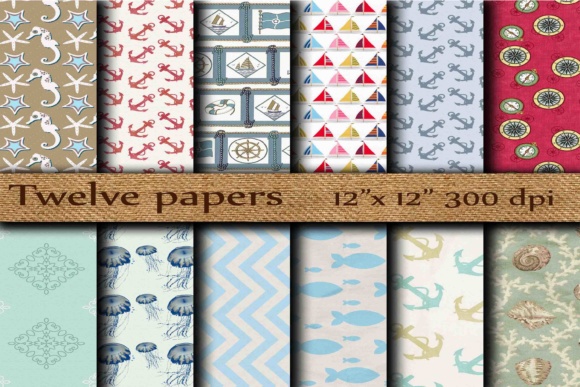
Nautical Digital Paper refers to a curated set of high-resolution, printable digital background patterns designed with maritime motifs—think blue and red ships, sea horses, octopuses, anchors, sailboats, ocean waves, and beach-inspired textures. Unlike generic clipart or stock photography, Nautical Digital Paper is built specifically for layered creative work: scrapbooking, cardmaking, lesson planning, classroom décor, digital invitations, and print-on-demand projects. Each file is a seamless 12×12 inch pattern at 300 dpi, delivered as a JPG—ensuring crisp output whether printed on home inkjet printers or professional presses.
What Sets Nautical Digital Paper Apart from Other Digital Backgrounds?
Many digital paper collections lean heavily into florals, geometrics, or abstract gradients—but Nautical Digital Paper maintains a consistent thematic focus without sacrificing versatility. The inclusion of both bold elements (like stylized red and blue ships) and subtle organic textures (such as watercolor-style sea horse silhouettes or muted coral-toned ocean papers) allows users to mix and match tones and scales across the set. This isn’t just “ocean-themed wallpaper.” It’s a coordinated system where color harmony, line weight, and motif density are calibrated so that a sailboat pattern doesn’t visually overwhelm an anchor or sea horse design when used side-by-side in a layout.
Unlike vector-based nautical graphics—which require editing software and technical know-how—Nautical Digital Paper works immediately in basic tools like Canva, Microsoft Word, or even PowerPoint. No layers to ungroup, no transparency issues to troubleshoot. You open the JPG, insert it as a background, and start designing. That simplicity matters especially for educators building marine biology unit packets or small-business owners creating coastal-themed branding assets on tight timelines.
How It Compares to Broader Categories of Digital Resources
When evaluating options, it helps to distinguish between three overlapping categories: digital papers, clipart packs, and SVG bundles.
- Digital papers serve as repeatable, full-coverage backgrounds—ideal for printed pages, journal covers, or digital planner templates. Nautical Digital Paper fits squarely here, optimized for coverage and cohesion.
- Clipart packs offer isolated, often transparent PNGs of individual objects (e.g., one octopus, one anchor). They’re flexible for layering but lack built-in rhythm or color continuity unless carefully curated.
- SVG files are scalable vector cut files—essential for Cricut or Silhouette users—but less practical for flat-print applications like worksheets or greeting cards unless converted and sized precisely.
Nautical Digital Paper sits in the middle ground: more structured than clipart, more accessible than SVG, and more thematically unified than generic digital paper sets. If your goal is to produce a batch of cohesive summer camp handouts—or a series of matching Etsy listing banners—the consistency across the 12 files becomes a tangible time-saver.
Realistic Use Cases and Where It Fits Best
Practical fit depends less on the theme and more on how you intend to use the files. Here’s where Nautical Digital Paper tends to deliver clear value:
- Educators designing ocean units: A teacher preparing a marine science module can use the sea horse paper for vocabulary flashcards, the anchor design for behavior charts, and the blue ship pattern for reading logs—all sharing the same palette and visual language. Students recognize continuity, which supports engagement without extra design effort.
- Small studios producing seasonal stationery: A boutique stationer launching a “Coastal Summer” collection can apply the red ship paper to thank-you cards, the octopus motif to gift tags, and the beach digital texture to envelope liners. Because all 12 files share resolution and aspect ratio, resizing and alignment stay predictable.
- DIY planners or bullet journal enthusiasts: Those customizing printable planners benefit from the 12×12 size—it tiles cleanly across standard A4 or letter-sized pages, and the 300 dpi resolution holds up under lamination or frequent handling.
Conversely, this set may not be the optimal choice if you need editable elements (e.g., changing the color of a single anchor), require transparency for overlay work, or plan to scale motifs far beyond 12 inches—JPGs don’t scale infinitely without pixelation. In those cases, pairing Nautical Digital Paper with a supplemental SVG or PNG pack often yields better results than relying on one format alone.
Tradeoffs to Consider Before Downloading
No digital resource is universally ideal—and understanding limitations helps avoid frustration later.
First, JPG format means no built-in transparency. If you’re layering text directly over a busy pattern like the octopus paper, contrast and legibility become design decisions you’ll manage manually—not features baked into the file. Some users prefer PNGs for this reason, especially when placing white text over dark blue waves.
Second, while the 12 designs are harmonized, they aren’t modular in a grid-based sense. You won’t find matching borders, frames, or corner accents included—just the 12 full-sheet patterns. That’s intentional: it keeps the set focused and avoids bloat. But if your workflow relies on coordinated borders or dividers, you’d need to source those separately—or adapt existing patterns using simple masking techniques.
Third, color accuracy varies slightly across devices and printers. The “blue” in the ocean papers may render cooler on a matte home printer versus warmer on a glossy commercial press. Soft-proofing on your target output device—or ordering a test print before bulk production—is advisable, especially for client-facing work.
When to Choose Nautical Digital Paper—and When to Look Elsewhere
Nautical Digital Paper is most effective when thematic consistency, ease of use, and print-ready quality are top priorities. It shines in scenarios where speed and coherence matter more than infinite customization: assembling classroom kits, prepping craft fair inventory, or supporting a short-term marketing campaign around coastal tourism or summer programming.
It’s less suited for highly technical workflows—like large-format wall murals requiring tileable vector repeats—or situations demanding brand-specific color matching (Pantone-referenced files, for example). Similarly, if your project hinges on animation, interactivity, or responsive web display, static JPGs won’t meet those needs; web-friendly formats like SVG or WebP would be more appropriate.
One helpful litmus test: ask whether you’ll primarily print or display digitally. Nautical Digital Paper is engineered for physical output—its 300 dpi resolution and 12×12 dimensions reflect that priority. For screen-only use (e.g., Zoom backgrounds or social media posts), lower-resolution, cropped versions might suffice—and could be generated from these files with minimal effort.
Making the Decision Without Overcomplicating It
At its core, choosing Nautical Digital Paper comes down to alignment—not just with a theme, but with your actual workflow. It’s not about whether “nautical” is trendy, but whether the specific combination of blue and red ships, sea horses, octopuses, anchors, sailboats, ocean papers, and beach digital textures solves a real problem you’re facing today.
If you’ve spent hours sourcing mismatched ocean images, adjusting colors individually, and wrestling with inconsistent sizing—this set offers a streamlined alternative. If you already have a robust library of vector nautical elements and prioritize scalability over speed, adding another JPG-based collection may introduce redundancy rather than efficiency.
There’s no universal “best” digital paper. There’s only what fits your current constraints: time, tools, output method, audience expectations, and aesthetic goals. Nautical Digital Paper meets a distinct niche—not by being the most feature-rich option available, but by delivering reliable, cohesive, ready-to-use assets for people who value clarity over complexity.